A practical selection guide for bulk liquids, viscous product, and dry material.
Whether you need a single tote or a national container program, the right container comes down to three things: what you are putting in it, how you handle and store it, and how many times it has to make the trip. This guide walks through how we work that out, and how you can narrow it down before we even talk.
Not sure after reading this? That is a good question to bring to us. Tell us what you are working with and we will take it from there.
Start With Your Product
Five questions decide most of the choice. Have rough answers to these and the right container usually becomes obvious.
- What is the liquid or material: water-like, viscous, corrosive, food-grade, solvent-based, or temperature-sensitive product all point to different containers and different materials.
- Does it need to stay clean or food-safe: food, beverage, and pharmaceutical product carry tighter requirements for materials, cleanability, and certification than general industrial fluids.
- Hot, cold, or thick: product that must be kept warm, that thickens or crystallizes in the cold, or that has to be pumped out changes the container choice and may call for heating.
- One-way or returnable: if containers come back to you for refill, durability, stackability, and reuse economics matter far more than the lowest upfront price.
- Volume, handling, and storage: annual volume, forklift access, how high you can stack, and how much floor or yard space you have all steer the decision. More on this below, because it is the part most buyers underestimate.
The Main Options
Caged IBC Totes
The workhorse of bulk liquid handling. A tough plastic inner bottle held in a steel cage, mounted on a pallet.
- Typical capacity: 1000 L (about 275 US gallons), with smaller sizes available.
- Construction: HDPE inner bottle in a galvanized steel cage, on a steel, composite, or wood pallet base.
- Outlets and fittings: commonly a 2 inch bottom ball valve with camlock or buttress adapters, and a large top fill and inspection cap.
- Options: food-grade resin, and UN or DOT rated versions for regulated dangerous goods.
- Best for: the widest range of general liquids where you want proven, cost-effective, forklift-friendly bulk handling.
- Watch-outs: not the first pick for aggressive chemistries or strict food and pharma work, where a cleaner, longer-life container earns its keep.
Stainless Steel IBCs (Supertainers)
The premium choice, and our niche. Built to be refilled and cleaned for years.
- Construction: 304 or 316 stainless, selected to suit the product and the cleaning regime.
- Strengths: thorough cleaning and clean-in-place, high and low temperature tolerance, resistance to aggressive product, and a long service life.
- Options: pressure and vacuum ratings, and fittings matched to your process.
- Best for: food, beverage, pharma, hot product, aggressive liquids, and any operation that wants one container it can reuse for years.
- Trade-off: higher upfront cost that is recovered over the life of the container. This is where we can specify the right grade and fittings for your exact process.
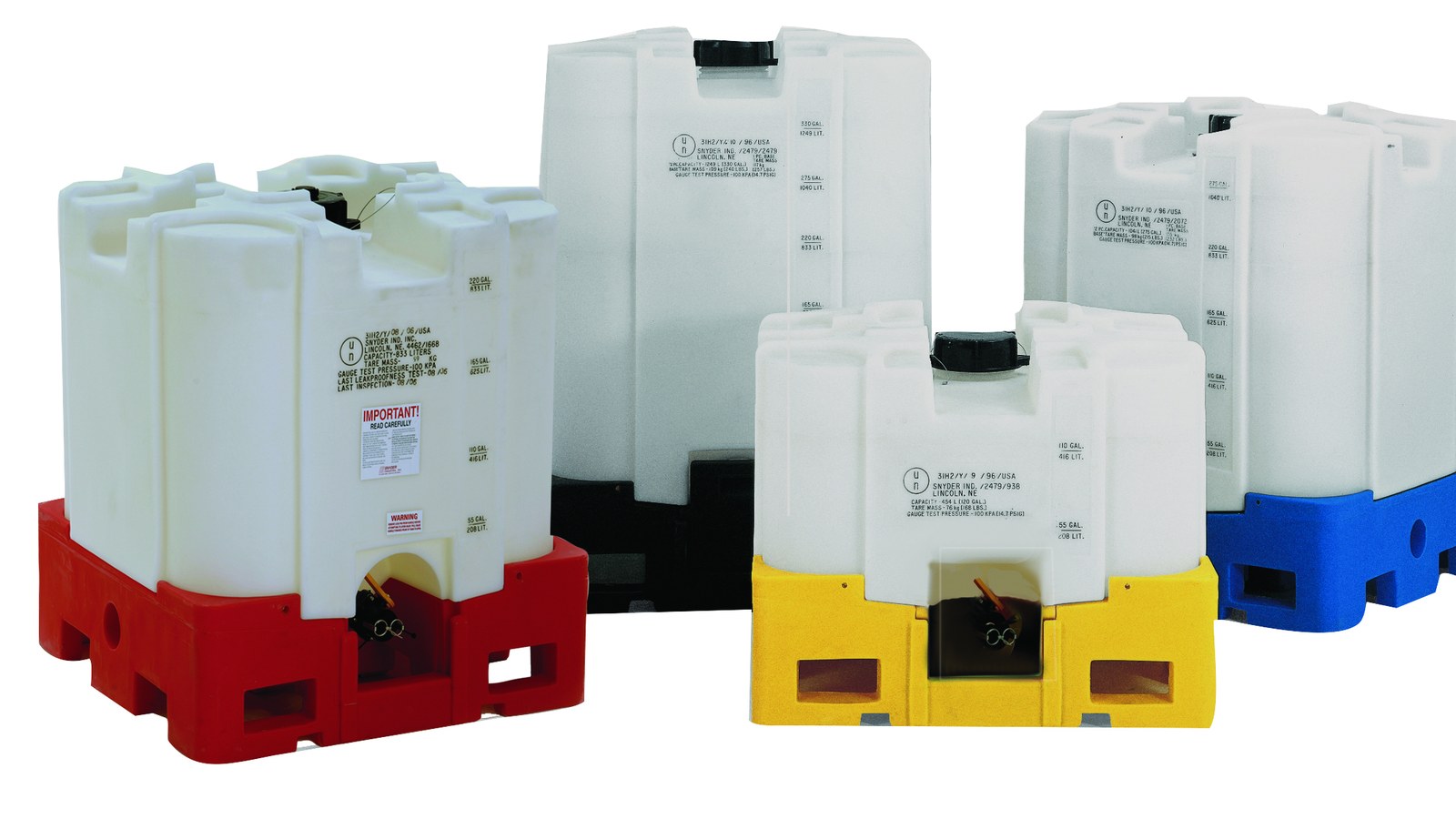
Square Stackable and Wide-Mouth Totes
Designed to save space and to handle thicker product.
- Capacities: commonly in the 120 to 350 gallon range depending on model.
- Strengths: a square footprint that uses floor and trailer space far better than round tanks, and a wide opening for easy filling and complete cleanout.
- Best for: tight floor space, viscous product, and anywhere a wide lid makes filling and cleaning easier.
Cagebuster
A rugged, cageless design for demanding handling.
Best for: tough environments and heavy repeated reuse where a traditional caged tote would take a beating.
Plastic Bulk Bins
For solids and material handling rather than liquids.
Best for: parts, ingredients, and dry product that needs sturdy, stackable, reusable bins. Many models nest empty to save space.
Bulk Bags (FIBCs)
For dry, flowable bulk.
Best for: powders and granular material moved by the tonne, when you want the lightest, most compact option. Food-grade liners and discharge options available.
Footprint, Stacking, and Storage: Plan It Before You Order
This is the part most buyers work out the hard way, after the containers arrive. A little forethought on footprint and storage saves freight, floor space, and headaches. Here is what to think through.
Know the footprint
A standard 1000 L caged IBC sits on roughly a 48 by 40 inch pallet footprint (about 1200 by 1000 mm) and stands around 46 inches tall (about 1150 to 1200 mm). That footprint is not a detail. It decides how the container fits your racking, your dock, and a trailer. Square Stackable totes are built specifically to make better use of that same space.
Stacking, filled and empty
- Filled 1000 L caged IBCs, at about 46 inches tall, are typically stacked three high in storage. Confirm the stack rating for your product weight before you plan racking.
- Empty containers stack or nest higher and lighter, which matters for both storage and return freight.
- Square Stackable and wide-mouth totes interlock and use vertical space more efficiently than round tanks, which is the main reason to choose them when space is tight.
Truckload and freight planning
A standard truckload is 60 caged 1000 L IBCs. Because Durastar is drop-ship only and delivers anywhere in Canada, sizing your orders around full or efficient truckloads keeps your landed cost per container down. We can help you plan an order that ships efficiently.
Returns and reverse logistics
If your containers come back for refill, the empty is now cargo too. Containers that nest or collapse when empty cut return freight and the yard space needed to hold them between fills. This is worth planning up front for any reusable or returnable program.
Where they will live
- Indoor versus outdoor storage, and whether product needs freeze protection through a Canadian winter.
- Secondary containment requirements for the liquids you store, which can affect layout and spacing.
- Aisle width and forklift access for the tote size and stack height you choose.
Bring us your storage space and your volume and we will factor footprint and stacking into the recommendation, not just the container itself.
Valves, Fittings, and Discharge
How you fill and empty the container matters as much as the container. Outlet size, valve type, camlock or buttress adapters, and top-fill versus pump access should match your equipment. Tell us how you fill and discharge and we will spec the fittings to suit.
Chemical Compatibility
The container material has to suit the product. The wrong pairing shortens container life or risks a failure. Our Material and Chemical Compatibility Chart covers common pairings, and when in doubt we confirm compatibility for your specific product before you order.
Food, Pharma, and Regulatory
Food-contact and pharmaceutical work call for the right resin or stainless grade, documented cleanability, and in some cases certification. Regulated dangerous goods require UN or DOT rated containers. We match the container to the compliance requirement so you are covered from the start.
Reusable and Returnable Programs
If your containers come back, the economics change. A container built to be refilled and returned many times usually beats a cheaper one-way option over its life. Our parent, K&S McKenzie, is the leading supplier of asset-returnable IBCs to the Canadian agro-chem industry, so returnable container programs are something we know well and can set up coast to coast.
Don’t Forget Heating
If your product needs to stay warm, thin out for pumping, or survive the cold, we pair containers with heating solutions from Thermon and IntelliHeat. It is easier to plan the container and the heat together than to bolt heating on later.
Think in Cost Per Year, Not Just Price
For any container you reuse, the number that matters is cost over its working life, not the sticker price. A more durable container with a higher upfront cost is often cheaper per year of service. Our Total Cost of Ownership page shows how that math works out over a container’s lifespan.
The Short Version
- General liquids, best value: caged IBC totes.
- Food, beverage, pharma, hot or aggressive product, long life: stainless Supertainers.
- Tight space or thick product: Square Stackable and wide-mouth totes.
- Rough handling and heavy reuse: Cagebuster.
- Solids and dry bulk: plastic bulk bins or bulk bags.
Still deciding is the normal place to be. Tell us your product, your volume, and how you handle and store it, and we will match you to the right container and get it delivered anywhere in Canada. Request a Quote 1-888-466-6649